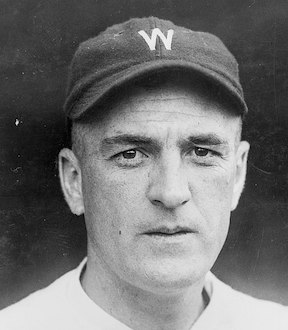
The Washington Nationals’ centennial celebration September 13-15 of the 1924 Washington Senators’ World Series title is a fitting moment to advocate for the one of that team’s stellar contributors’ overdue inclusion into the M.L.B.’s Hall of Fame: Joe Judge.
In that seven game triumph over the New York Giants, Judge hit .385: The highest average on his team for guys who played all seven games. Collecting ten hits and walking five times in 31 plate appearances, the first baseman’s .484 O.B.P. led the team.
And his .907 O.P.S., among players who played all seven games, was second on the team to Hall of Famer Goose Goslin’s .1000 O.P.S.
Producing numbers like these over his distinguished, if under-rated 20-year career – 18 of which were spent with the Senators – earned Judge a place in the Washington D.C. Sports Hall of Fame.
100 years after his greatest accomplishment and 90 years after he retired, it’s time for the M.LB.’s Hall of Fame to give Judge the national recognition he properly deserves. I admit some bias making this case.
My dear friend of 48 years, the late Mike Judge was Judge’s grandson, and as the Georgetown University varsity baseball coach, Judge coached my Uncle Bill Byrd and my father’s good friend and former Washington fullback and defensive tackle Jim Castiglia.
A close examination of Judge’s record, however, warrants my advocacy.
These prominent stats speak to Judge’s Hall of Fame credentials. Nine decades removed from the game, the first baseman ranks 136th all-time in the M.L.B. for hits, with 2,352. That’s more than Hall of Famers Joe DiMaggio, Yogi Berra and Mike Schmidt.
With 159, Judge ranks 42nd all-time for triples, ahead of Hall of Famers Lou Brock, Willie Mays and George Brett.
Though undersized for a first baseman at five-eight and playing with a more rudimentary glove, Judge nonetheless excelled defensively.
July 1, 1920, diving to his left into foul territory, the lefty snared Boston Red Sox’s right fielder Harry Hooper’s hot smash and tossed the ball to the covering Walter Johnson, who beat Hooper to the bag.
Thus, Judge spectacularly rescued Johnson’s no-hitter, astonishingly the only one the Montanan threw in his storied career of 417 victories.
(Hitting .281 with a career .755 O.P.S., Hooper is in the Hall of Fame while Judge, with career totals of .298 and .798, remains excluded.)
Comparing Judge’s record against others in the hall is the best way to understand why Judge’s exclusion is unfair. Measuring the first baseman’s achievements against players from the same franchise, the evidence will become clearer.
(After the 1960 season, the Senators became the Minnesota Twins. Washingtonians of a certain vintage still loathe the team’s owner Calvin Griffith for the move that deprived them of the chance to see Rod Carew, Bert Blyleven and Jack Morris play.)
Let’s compare Judge’s record against the Twins’ most recent Hall of Fame inductees: Tony Oliva and Joe Mauer.
Third all-time in Twins’ history, Judge collected 2,291 hits for the franchise, while Mauer is fourth with 2,123 and Oliva is ninth with 1,917. The first baseman still ranks second among Twins’ triples leaders. Mauer and Oliva aren’t in the top 25.
Mauer ranks second among Twins all time in doubles, with 428, and Judge is third with 421. But, for his career, Judge hit 433 doubles. And he ranks fourth all time in franchise history in extra base hits with 649, while Mauer is seventh with 601 and Oliva is eighth with 597.
Judge has also more total bases than the duo: 3,329 for him, 3,040 for Mauer and 3,002 for Oliva. And he has more walks: 943 for Judge, 939 for Mauer and 448 for Oliva.
O.P.S., O.P.B. and homers are the only areas where Mauer and Oliva have better numbers than Judge. Oliva’s O.P.S. is .830, Mauer’s .827 and Judge’s .802. Mauer’s O.P.B. is .389, Judge’s is .379 but Oliva’s is .353.
Each player’s homer totals are not-bound-for-Cooperstown numbers: 220 for Oliva, 143 for Mauer and 71 for Judge.
In Twins’ franchise, history, Judge is in the top five in seven offensive categories: hits, singles, doubles, triples, walks, extra base hits and total bases, and his career numbers in these areas are better than the two Twins’ Hall of Famers.
The fact that Oliva and especially Mauer played in more competitive eras shouldn’t diminish Judge’s achievements. He’s demonstrably as worthy as they are to be in the Hall of Fame as one of the best in Twins’ franchise history.
This best-of-franchise standard suggests a possible way for the Hall of Fame to inject more fairness into their subjective and arbitrary process that has largely depended upon sportswriters’ whims and iconoclasm.
Regarding Judge’s case as an opportunity to establish more universal benchmarks for future evaluations, the M.L.B. Hall of Fame Era Committee should look at his numbers, consider the facts, follow the logic and repair their omission, which has persisted 85 years since Judge was first eligible for the Hall in 1939.
And put Joe Judge in the Hall of Fame where he has long belonged.

 Chris Byrd
Leave a comment