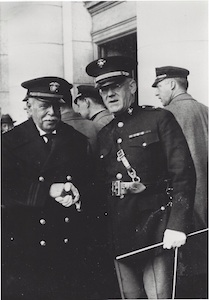
Fabled bandleader John Philip Sousa’s (1854 – 1932) immortal march “The Washington Post” debuted 135 years ago on June 15.
The famous conductor and my maternal grandfather Captain Taylor Branson’s (1881 – 1969) special association also began that day. Consider the following coincidences that deepened their connection.
Both native Washingtonians led the marine band. Among this select fraternity of 29, Sousa was the 17th and Branson the 20th leader. Sousa was the band’s first native born leader while Branson was the first born to native parents.
Both were accomplished violinists before becoming conductors. Sousa was a member of Christ Episcopal Church in Barracks Row, which the Bransons attended before my Great-grandfather J.T. Branson converted to Catholicism.
One-tenth of Washington’s population then of 250,000 – 25,000 people, including President Benjamin Harrison – assembled on the Smithsonian grounds that June day the leaders met.
The crowd came to celebrate the 2,200 school children who participated in “The Post’s” Amateur Authors’ Association essay contest, including from Maple View Van Buren Elementary School second grader Taylor Branson. (In Sisters, I wrote he was one of 11 Gold Medal winners, which further research uncovered wasn’t the case.)
“Post” Publishers Frank Hatton and Beriah Wilkins hoped the contest would gain the upstart morning periodical a competitive edge over the more established afternoon paper, “The Washington Evening Star.”
During a chance encounter with Sousa, the publishers prevailed upon him to write and perform a march to elevate the ceremony honoring the contest winners.
The crowd “applauded heartily” as the Marine Band performed, “the light and melodious” two-step number, as the paper described it. It published “The Washington Post” on its front page the next day. The composition transformed Sousa into “The March King.”
In retrospect, it must have cheered my grandfather to have been there when this legend took hold, but he cherished a memory, dearer to him then what the crowd experienced.
According to family lore, he, received a medal from Sousa that day. And, Pete, as we called him, sat in Sousa’s lap, basking in the moment’s headiness, forming the special bond, which lasted until Sousa’s death.
As Sousa inspired Pete at his journey’s outset, he supported Sousa at the end of his.
In Pete’s 5th year as bandleader, they were together at the U.S. Capitol February 22, 1932, when Sousa conducted a joint military band performing his “George Washington Bicentennial” march written for a ceremony to commemorate the first president’s birth.
At an evening of skits, music and speeches, the 32nd annual Wallow of the Military Order of the Carabao at the Willard Hotel Saturday, February 27, 1932, a week before Sousa died they reunited one final time.
Leading the band, Pete transferred the baton to the retired naval lieutenant commander Sousa, who conducted his “Hands Across the Sea” march.
A highly spirited rendition of “The Stars and Stripes Forever” followed, which deeply moved the audience, which included Army Chief of Staff General Douglas MacArthur. And many eyes filled with tears, not knowing it was composer’s last live performance.
At 77, Sousa died Sunday, March 6, 1932 in Reading, Pennsylvania. My grandfather’s diary recalls the Washington events, which memorialized him. Sousa’s body arrived at Union Station at 7:00 p.m. that night.
Monday, March 7 and Tuesday, March 8, the band performed tribute concerts at the Marine Band auditorium, broadcast on W.R.C. radio. Before the initial broadcast, Captain Branson, as quoted in “The Washington Post,” said, “John Philip Sousa was an American patriot, a musician, a master bandsman, a sportsman and a man among men.”
“John Philip Sousa was an American patriot, a musician, a master bandsman, a sportsman and a man among men.”
Taylor Branson
Wednesday, March 9 Gawler’s Funeral Home delivered Sousa’s body to the auditorium for public viewing 3:00 – 10:00 p.m.
Broadcast nationally on radio, Sousa’s funeral was held there Thursday, March 10 at 3:00 p.m.
The Navy’s Chief Chaplain Sidney Evans preached the lesson and Christ Episcopal Church Rector Edward Gabler read from the Psalms. Notable honorary pallbearers, according to my grandfather, included: A.S.C.A.P. President Gene Buck, operetta composer Sigmund Romberg and storied vaudeville and Broadway performer George M. Cohan.
In front row of the barracks hall, according to “The Post,” Sousa’s widow Jane, his daughters and another female family member, sat, “heavily veiled and crying.”
During the 15 minute service, the Gridiron Club Quartet sang “Abide With Me” and “Jesus, Lover of My Soul.”
And “Nearer My God to Thee” was played, as “The Post” reporter described it, “as the casket was borne from the hall. Marines and blue jackets formed a guard of honor on either side of a flag-draped black caisson.”
“And the barrack gates were thrown open, as the band played one of Sousa’s beloved marches, ‘El Capitan’ in slow time. And the cortege accompanied the caisson pulled by eight snow-white horses toward Congressional Cemetery.”
On “the beautiful but cold day,” my grandfather wrote, along the one and a half mile journey to the cemetery, the band played Sousa numbers “Semper Fidelis” (in dirge time), “Garfield’s Funeral March,” and “Honored Dead” among other numbers.
To pay their respects to the fallen legend, according to “The Post” reporter, “curious yet reverent” throngs gathered along 8th Street S.E., Potomac Avenue and at the cemetery’s main gate at E Street S.E.
Graveside, marines fired three volleys of rifle shots, and the band’s second leader Arthur S. Witcomb sounded “Taps,” as America’s premier bandleader was laid to his eternal rest.
Now when people remember John Philip Sousa, as band members do each November 6 when they visit Sousa’s grave on his birthday, I hope they also remember Taylor Branson.
Editor’s Note: Taylor Branson’s diary excerpts used with permission from U.S. Marine Band Library and Archives.

 Chris Byrd
Leave a comment